|
Contact: Anabel Jay
|
Tel: 01773 520538 Mob: 07784128026
email: anabel@eponahispano-arabe.co.uk
|
|
|
Spain has always been heavily dependant upon horses; more than any other country her
fortunes have 'ridden' upon the prowess of her famous fighting war horses. Due to Spain's
history it is perhaps not surprising to find that the military, with their need for cavalry
remounts alongside Spain's national sport of bullfighting, have been key factors in shaping
the development of all horses in Spain.
To this day, in the form of the Cria Caballar,the military still exerts its influence regardless
of the mechanisation of modern warfare; should the need arise, Spain can call upon her
famous fighting horses in the certainty that they are still unsurpassed in battle as their
fore-bearers that carried the might of the Conquistadors.
|

Royal Spanish Husar ~1833 | |
The SPANISH ARABIAN (PRá)
Spain's official Arabian Horse records date back to
1884 although obviously with a history of conflict and
occupation with the Moors, the desert Arabian had
established itself in Spain long before that.
In the 1800's when Arabian horses were selected from
European stocks with a view to improving the existing
Arabian herds and the Pure Spanish /Andalusian, it was
the needs of the military and bullring that influenced the
type of horses to be imported. Spain sought horses as
near as possible similar in type to the horses of Spain,
they selected not just for looks but for performance. |
Many came from countries like Poland and Russia, who like the Spanish had a long
history of breeding remounts for their cavalry as well as plying their Arab horses to
heavy duty work (ie. in Poland the Arab used as a farm plough/cart horse also doubled
as a military remount!)
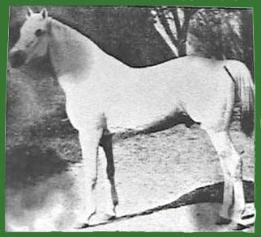
Wan Dyck imported from Russia
exerted considerable influence upon the
Spanish Arabian Horse and to this day
his descendants distinguish themselves.
|
|
|
The military needs and concept of the Andalusian phenotype has influenced the
breeding of Arabs in Spain resulting in a very distinct horse that is undeniably a Spanish
Arabian. Although the horse is still pure blooded it has in general developed a striking
resemblance to the Andalusian, exhibiting the same straight flat shoulder and forearm,
and a noticeable straight facial profile. (In more recent times with the expansion of
Spain's Arabians into other countries, Spain has likewise started to import more diverse
Arabian types; so it's own Arabian with new breeding diversity is starting to change).
|
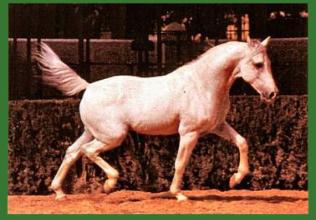
Classic Spanish Arabian
descendant of Wan Dyck;
Kadi is sire of Baal,
one of the Spanish Arabians
used extensively with significant effect
by the Cria Caballar for
the Hispano-Árabe breed improvement
|
|
It is this similarity of physical appearance of the traditional Spanish Arabian that more
than anything holds the key to the breeding of the Hispano-Árabe. Generally when using
Arabs to cross with other breeds, one expects the Arab to be pre-potent and clearly set
it's dominant stamp upon the resulting offspring. However, when crossed with the
Andalusian (bearing in mind that since the 1800's this already has some Arabian blood)
it would appear that it is the 'Iberian Factor' that is dominant. In reality what is happening
is the reinforcement of mutual physical characteristics that have already been selected to
exist independently in both breeds. The external factor that created this similarity was the
performance needs of the military.
|
|
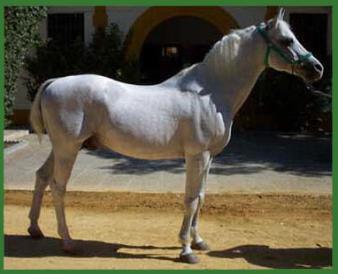
Spanish Arabian Vatoli (1979)
5th generation from Wan Dyck
and grandsire of Spain's 2010
Champion of Champions
Hispano-Árabe
|
© Leopard Studios |
|
|