|
Contact: Anabel Jay
|
Tel: 01773 520538 Mob: 07784128026
email: anabel@eponahispano-arabe.co.uk
|
|
|
The HISPANO-ÁRABE (Há)
In phenotype type the Hispano-Árabe falls in the middle of the two phenotypes types of Pure Spanish Horse.
It's conception as a breed in Andalusia dates to the Muslim invasion of the Iberian Peninsular with the earliest records of selective breeding for Hispano-Árabes dating back
to 1778. The continued selection for the Hispano-Árabe arising from it's popularity as an
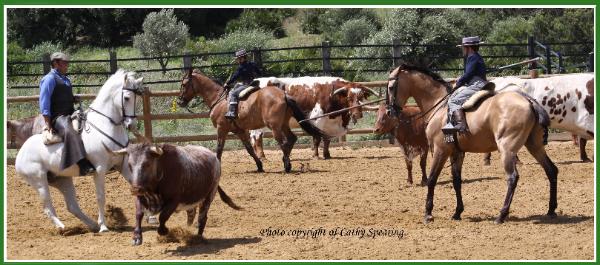
excellent stock horse, proving both highly trainable, courageous and work hardy as well
as a comfortable ride for long hours working the famous bull ranches of Spain.
A resurgence of interest occurred in the 1880's when European Arabians were imported
as a part of a general equine improvement programme, resulting in some breeders being
so impressed with the versatility of the Hispano-Árabe that they continued to specifically
breed them, long after the Andalusian improvement programme finished.
At an official level no particular heed was paid to the development of these horses, they
were crossbreeds and as such were registered as "Cruzados". Hispano-Árabe was crossed to Hispano-Árabe or to Andalusian or to Arab with the work demands as a stock horse
dictating the breeding selection process. Steadily a horse was developing which exhibited
it's own particular pre-potence and breed type.
Mares are selected for their temperament and nurturing instinct. The stallions on the
other hand have always had to prove their suitability for breeding by their performance
in whatever sphere of work they are put to. Understandably this has led to a 'natural
selection' of physical characteristics and obviously the associated genetics.
Selection along these lines creates a gene poole that is fixed, the horses will always breed
true to type, they are pre-potent. This is the principle that dictates that a type of horse is
a specific 'breed'.
The Hispano-Árabe was bred and used in the fields herding and working the bulls and
for the bullring. The physical characteristics that have proved themselves in performing
the Doma Vaquera skills to handle the famous black bulls and the High School fighting
manoeuvres integral to this sport; are those identified as the Iberian Factor. The
Hispano-Árabe in appearance is like the old classical Andalusian, unmistakably Iberian
but with the edge that these horses inherited from the Arabian of added speed and dash.
Although in the past registered as partbred/cruzados the papers always specified the
breeding so there was no mistaking the horse as anything but a Hispano-Árabe. These
horses were highly prized for their versatility, indeed they were so popular that for many
years horse breeders such as Alvaro Domecq; a strong advocate for the Hispano-Árabe,
lobbied to have this successful breed accepted into a special section of the Spanish State
Stud Book.
| |
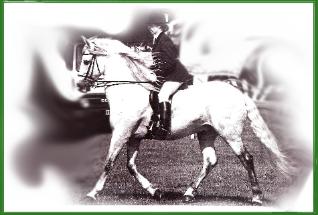
Piyayo
first UK imported Hispano-Árabe;
in 1984, at the time Spain was formalising
the breed and establishing the
State Stud Book for Hispano-Árabes.
Foundation lines with no traceable
Arabian blood, bred for performance
as a versatile Hispano-Árabe
from working horses
|
In 1986 the Hispano-Árabe officially was given its own Stud Book and full recognition
as a breed in its own right requiring protection and a breed regeneration/improvement
plan, due to its dwindling numbers . Existing Hispano-Árabes were submitted for grading
and entry into the Foundation Stud Book. Hispano-Árabes from that point on would
either be the offspring of foundation horses or the result of first generation crossings of
Arab and Pure Spanish Horses and subsequent blending of the two.
Ansarito CD 50%
4yr old Hispano-Árabe
2010 Champion of Champions
Ansarito is descended from Wan Dyck
through his paternal grandsire Vatoli (PRá)
being the most recent introduction of Arab
bloodlines as the rest of his breeding is
from established Hispano-Árabes
|  |
The Hispano-Árabe is pre-potent in its own right. They will continue to breed true to
type for several generations and not show a phenotype diversification of its progeny.
The pre-potence of the Hispano-Árabe applies to its matings with other breeds of horse,
the partbred stock should be physically (and mentally) well balanced...
......not Heinz Specials !!
To breed first generation Pura Raza Hispano-Árabe (PRHá) the old strongly Iberian
type Spanish Horses exhibiting the well muscled classical build should be used with
Arabs of similar physical type (see the Spanish Arab).
To quote Sylvia Loch and many wise horse breeders ...
"The important rule of cross-breeding is that sound pure-breds with well defined
physical characteristics are used on both sides, the splendid Domecq Hispano-Árabes
which have become famous throughout Spain clearly show more than a fair share of the
Iberian Factor."
© Leopard Studios |
|
|